|
LISTENING TO THE SKY Receiving
and listening techniques for monitoring military satellites.
Published in the WANSAC (Western
& Northern Suburbs Amateur Radio Club) monthly club magazine.
Issue
August 2026
http://www.wansarc.org.au/
UFO-11 a Military Workhorse in a Noisy Sky
By
Peter Miles – VK6YSF
For
many radio amateurs and SDR radio listeners, the first encounter
with military UHF satellite communications is a high point –
pardon the pun. Tune across the 240–270 MHz range with the right
setup, and you may hear brief voice exchanges, digital bursts or
often something far less official.
At
the centre of much of this activity sits UFO-11,
one of the U.S. Navy’s long-serving UHF Follow-On (UFO)
satellites. UFO – someone in the Pentagon has a great sense of
humour. To the monitoring community, it has gained a reputation not
only as a reliable signal source, but also as a place where
structured military communications and unauthorised transmissions
appear to share the same spectrum.
So
what’s really going on up there - and how does it all work?
UFO-11
is a geostationary satellite, or more accurately, a geosynchronous
satellite with orbital inclination. Over time, its orbit has been
allowed to tilt slightly relative to the equator, producing the
familiar figure-8 ground track when plotted over a 24-hour period.
For
the satellite operator, this is a deliberate trade-off. Maintaining
a perfectly fixed position requires continuous north–south
station-keeping burns, consuming valuable fuel. By relaxing this
requirement, the satellite’s operational life can be extended
significantly and often by decades.
From
a monitoring perspective, this has a subtle but noticeable effects
in that daily variation in elevation angle and may have small
changes in signal strength and a slight pointing tolerance for
directional antennas, however UHF in this situation is sufficiently
forgiving with the few degrees change of inclination rarely cause
problems for end users or listeners. For listeners in Melbourne,
Australia, this places UFO-11 either just above or just below the
horizon, depending on the time of day. When it is just above the
horizon, reception should likely be possible, provided there are no
buildings obstructing the line of sight.
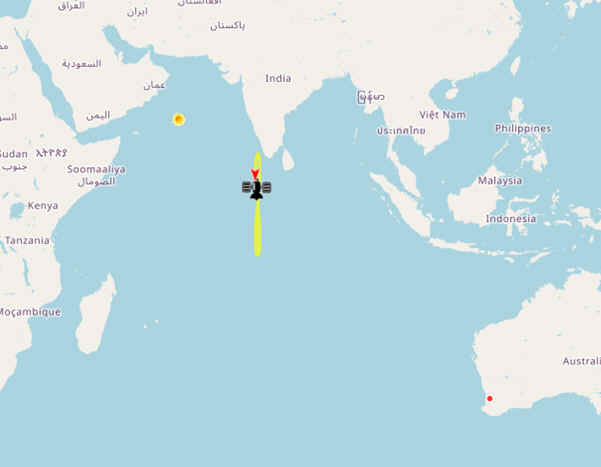
Fig
1.
UFO-11 geostationary
orbit positioned over the Indian Ocean with a figure of 8 ground
track.
Technically,
UFO-11 is straightforward. It is a bent-pipe
repeater. Signals are received on one frequency, translated
to another frequency, amplified and retransmitted with no on-board
decoding or routing. The satellite simply relays whatever it hears.
Its
primary operating ranges are well known:
Channel spacing is typically narrow (5 kHz or 25 kHz), supporting, narrowband FM voice, low-rate digital modes, other higher bandwidth and control channels.
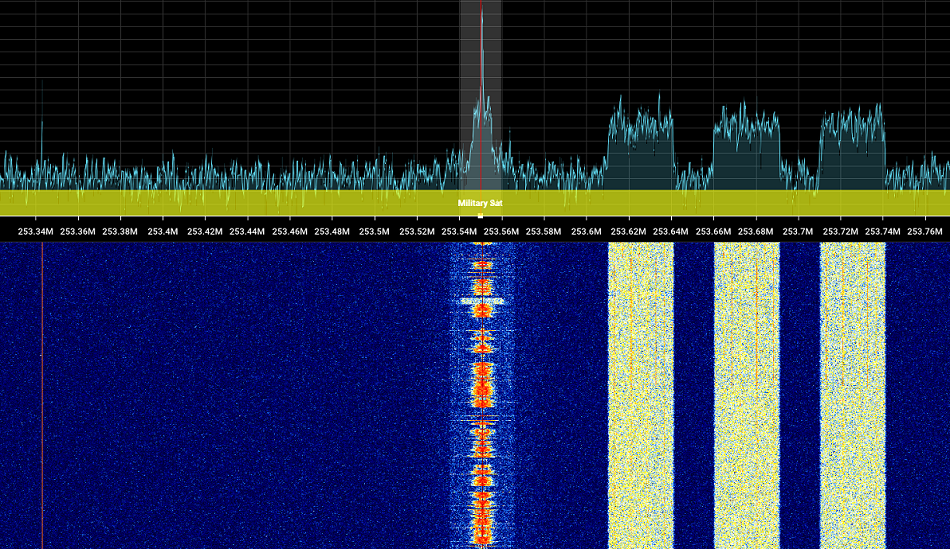
Fig
2.
SDR receiver spectrum showing four channels. The centre with voice
traffic and the three to the right showing channel noise floor.
For
the listening public, this makes UFO satellites particularly
interesting. Unlike many modern systems, the signals are narrowband,
often within reach of modest equipment and detectable with an SDR
receiver and suitable antenna such as a small Yagi.
Spend
a little time monitoring these frequencies and you’ll likely
encounter something unexpected: transmissions that don’t sound
military at all.
These
may include, casual voice chats, music and broadcasting - mostly
foreign-language traffic.
This
has led to the widespread belief that UFO satellites are easily
disrupted. While there is some truth to that, it’s important not
to misinterpret what you’re hearing.
In
reality, the critical traffic is usually happening elsewhere in the band, out of the spotlight.
A
natural question is: why isn’t this shut down? - The answer
lies in the nature of radio itself.
Regulators like the Australian Communications and Media Authority or the United States - Federal Communications Commission can enforce rules within their own borders. But satellite uplinks can originate from anywhere within the footprint that can spans continents and oceans.
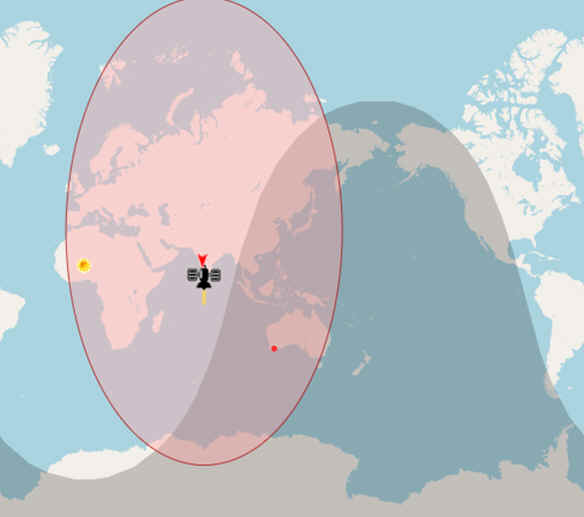
Fig
3.
UFO-11 coverage footprint.
International
coordination exists via the International Telecommunication Union,
however enforcement relies on cooperation. There’s no
global enforcement body that can simply “switch off” an
offending transmitter.
Add
to that the mobile transmitters, wide-area coverage, difficulty
geolocation and you have a classic RF cat-and-mouse problem.
In
some cases, transmissions attributed to countries such as Russia may
not be “pirate” at all, but deliberate state-level activity -
jamming, spoofing, or opportunistic use. That moves the issue from
regulation into geopolitics.
From
a technical and operational standpoint, the key question is whether
this activity degrades the system and in most cases, the answer is: not significantly.
With
most operational traffic being encrypted. Even if you can hear it,
you can’t interpret it.
There
is also the flexibility to
change channels, adjust power or even switch satellites. Importantly
these are military assets that are required to operate under adverse
conditions including deliberate attempts at disruption.
Monitoring
activity has taken on new relevance in the context of the war in
Ukraine.
There
have been credible however
unconfirmed reports that forces associated with Russia may
have used legacy UHF satcom systems, including UFO satellites,
during the conflict.
The
monitoring community has reported a lot of Russian-language voice
traffic often unencrypted communications that appear operational
military or just covering deficiencies in Russian military
communication infrastructure - all of this is unconfirmed.
However
hearing a signal does not confirm the satellite used and nor does it
confirm the identity of the operator.
Many
transmissions are simply radio pirates that in the case of UFO-11
are mostly Russian from my listening.
What
is clear is that satellite communications are now a contested domain, and legacy systems may be used opportunistically
when needed.
All
this raises an interesting question: does this kind of activity
actually benefit intelligence agencies such as the National Security
Agency or the Central Intelligence Agency?
In
theory, it can - at least occasionally. Unsecured transmissions may
reveal radio procedures, operational habits and in some cases troop
morel.
Even
encrypted signals provide metadata who is transmitting, when, and
how often.
The
catch is that it also create opportunities for deception and low
quality information, or in other words a signal to noise
situation.
Not
everything heard is what it seems.
It’s
also worth noting that UFO-11 is no longer the primary system it
once was. Much of its role, but not all has been taken over by the U.S.
Space Force and U.S. Navy’s
MUOS
(Mobile User Objective System)
constellation.
MUOS
is digital with tight access controls, greater capacity and
security; and for the monitoring folks, it’s also far far less
accessible.
For
radio amateurs, UFO-11 offers something increasingly rare, a real-world, active satellite system, signals that can still be
observed with modest gear and glimpse into how a space based
communications systems behave under imperfect conditions.
This
is also fantastic opportunity to test and refine radio techniques
quickly in a way that separates reality from theory.
With
an SDR receiver, the experience shifts from simply hearing signals
to seeing the entire band in
motion.
The
SDR waterfall display reveals channel occupancy patterns, burst
transmissions and control channels
Upper
VHF and UHF frequencies are ideal for practical antenna design and
construction work. Designs are compact, materials are inexpensive,
and results are immediately measurable.
An exciting
new area to explore is the application of AI (Artificial
Intelligence) in conjunction with Speech Note software (Linux) for
speech-to-text transcription and translation tasks. Speech Note can
utilise speech recognition engines such as Whisper (including local
implementations of OpenAI’s Whisper models, e.g. whisper.cpp or
faster-whisper) to convert audio into text, and optionally pass that
text through translation engines for language conversion.
Speech Note
is an audio-to-text application capable of near real-time processing
depending on configuration and system performance. A practical use
case is routing audio from an SDR (Software Defined Radio) receiver
into Speech Note, allowing received voice signals to be transcribed.
This is typically achieved using virtual audio routing via
PulseAudio or PipeWire (Linux) or VB-Cable
(Windows) between software applications.
Performance
depends heavily on the selected speech recognition model. Smaller
Whisper models (e.g. tiny or base) offer faster processing with
lower accuracy, making them suitable for near real-time
transcription of cleaner signals. Larger models (e.g. medium or
large) provide higher accuracy and improved noise robustness but
require significantly more processing time and are generally not
real-time on modest computer.
This makes
the system suitable for transcribing radio voice communications (AM,
SSB, FM) as an alternative to simple audio recording, with the added
capability of processing in near real-time transcription. When
combined with translation models, it can also provide language
identification and conversion (e.g. Russian to English), although
translation introduces additional latency beyond the speech
recognition stage.
Even
when transmissions can’t be decoded, they can still be studied.
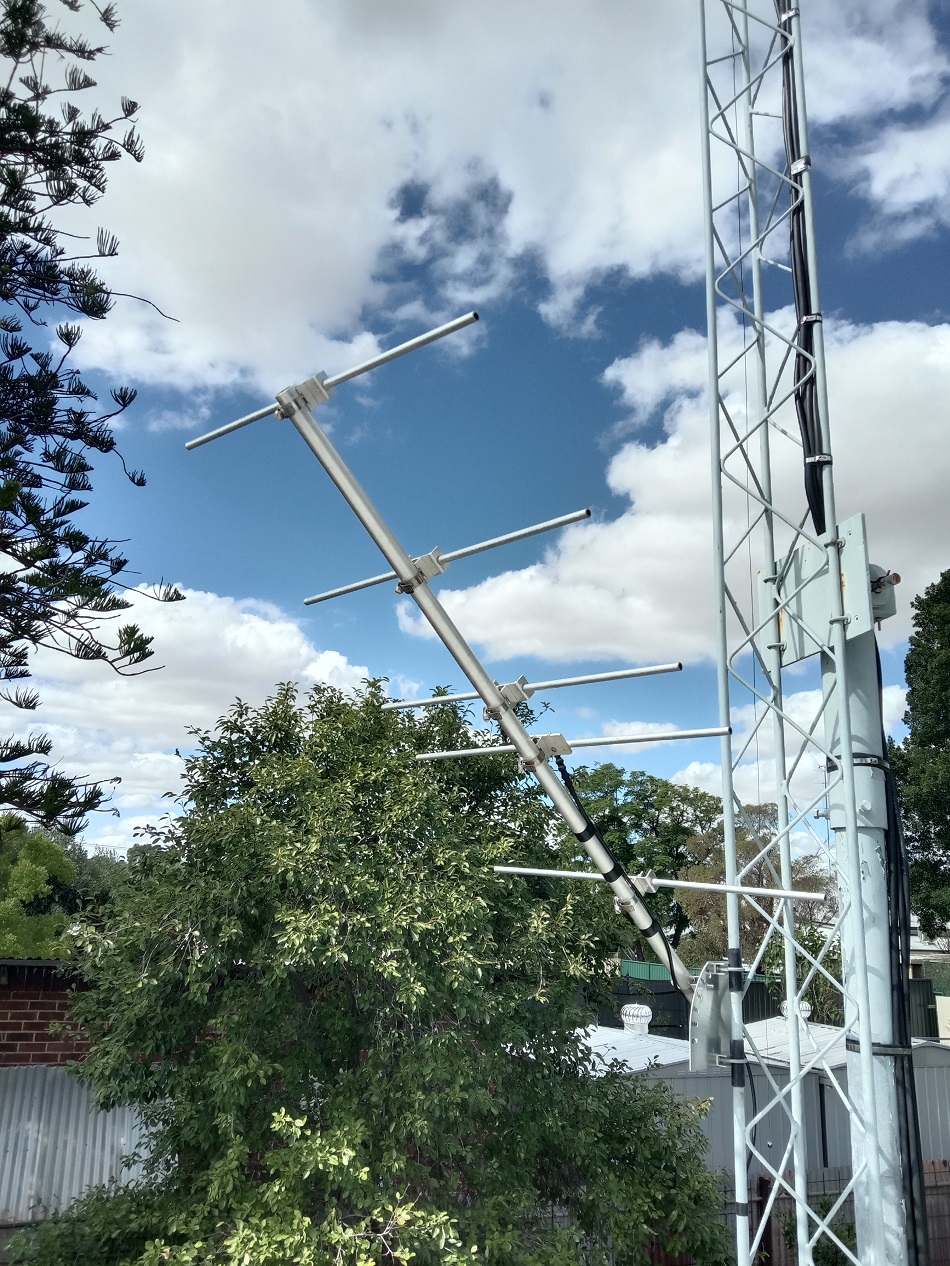
Photo
1.
A 5 element Yagi antenna aimed at the UFO-11 satellite.
It’s
a rare glimpse into a working communications network operating under
real constraints and chaos.
As
newer systems like the MUOS
take over, much of this activity is moving toward more controlled,
less observable platforms.
This
makes the UFO-era satellites something of a last
accessible frontier for this kind of hands-on learning.
For
the amateur experimenter, this isn’t just casual listening. It’s
a chance to refine equipment under realistic conditions, develop
practical SDR and analysis skills, build and evaluate antennas with
immediate feedback and gain insight into complex RF systems
Tracking
UFO-11: https://www.n2yo.com/?s=28117&live=1
Conclusion
UFO-11
is not a pristine, tightly controlled communications platform. It is
something more interesting: a practical
system operating in the real RF world.
Yes,
there is unauthorised activity. Yes, it can be heard. But rather
than undermining the system, it highlights its strengths, including
its resilience, flexibility and tolerance to interference
For
the listener, it offers the opportunity to observe a living system,
but also a reminder that what we hear is only part of a much larger
and more complex picture.
In
an increasingly digital and closed communications landscape, that
alone makes UFO-11 worth tuning in to.
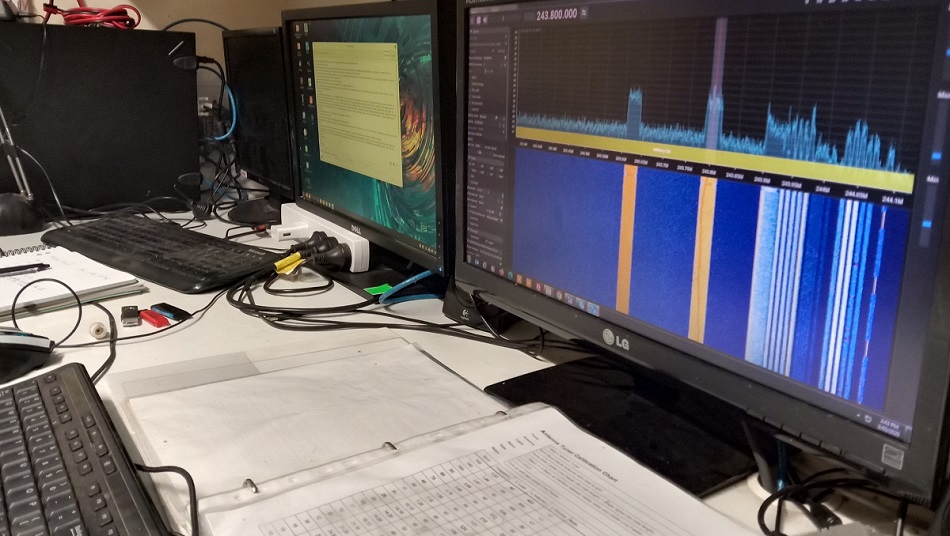
Photo
2.
Station listening to the UFO-11 satellite while transcribing
and translating Russian radio pirate voice traffic – tell
me this doesn’t look like fun.
Cautionary
Legal Note:
If
a transmission is not clearly intended for public reception, treat
it as receive-only. Avoid recording, publishing, disclosing,
retransmitting, or otherwise distributing the content.
Receiving
unauthorised or “pirate” transmissions is generally treated
differently from transmitting them; however may raise legal issues
depending on jurisdiction and the nature of the signals involved.
Extra
caution applies to any communications associated with military or
government systems, regardless of whether they appear unsecured or
originate from unauthorised users.
References:
5
Element Yagi-Uda antenna for 250MHz to 260MHz.
https://vk6ysf.com/yagi_250mhz_5el_20220925.html
Speech
Note (Linux) speech-to-text tool that transcribe audio and even
translate between languages.
https://flathub.org/en/apps/net.mkiol.SpeechNote
StarWhisper
v1.3.130 is a Windows alternative to the Linux Speech Note.
https://apps.microsoft.com/detail/9nxrf1n01vsn?hl=en-GB&gl=AU
TOP
OF PAGE
Page initiated
04 August, 2026
Page
last revised 10 August, 2026
|