|
STEREO AMPLIFIER / LM380 Small
stereo amplifier to a power a set of desktop speakers for a PC.
Requiring
a small stereo amplifier to a power a set of desktop speakers for a PC. The amplifier is built around two LM380 integrated circuits that
will deliver about 2 Watts per channel of clean audio.
The
LM380 is a classic audio power amplifier integrated circuit that has
remained popular for over 40 years. Although originally intended for
applications such as intercoms, portable radios, and communications
equipment, it also makes an excellent low-power stereo amplifier for
a desktop computer.
By
using two LM380 integrated circuits, one for the left channel and
one for the right channel, it is possible to build a simple,
reliable stereo amplifier capable of delivering around 2 watts per
channel into 8-ohm speakers from a 12 to 18-volt power supply.
The
circuit requires very few external components, making it an ideal
project for a quality desktop amplifier.
The
LM380 is a monolithic audio power amplifier with several useful
internal features including:
-
Fixed
voltage gain of 34 dB (×50)
-
Internal
thermal shutdown
-
Short-circuit
protection
-
Low
component count
-
Good
power supply rejection
-
Stable
operation without external compensation
Circuit
description.
The 14-pin LM380N was chosen
as opposed to the 8 pin variant because this package is designed to help remove heat from the amplifier.
Unlike many integrated circuits, the LM380 has eight ground pins (pins 3–7 and 10–12). These pins are all connected together inside the chip and are attached to the metal frame inside the package. This allows heat to flow from the silicon chip into the printed circuit board (PCB).
By connecting these ground pins to large copper areas on the PCB, the board acts like a heat sink, helping to spread and release heat into the surrounding air. This often removes enough heat that a separate metal heat sink is not needed for low- to medium-power applications.
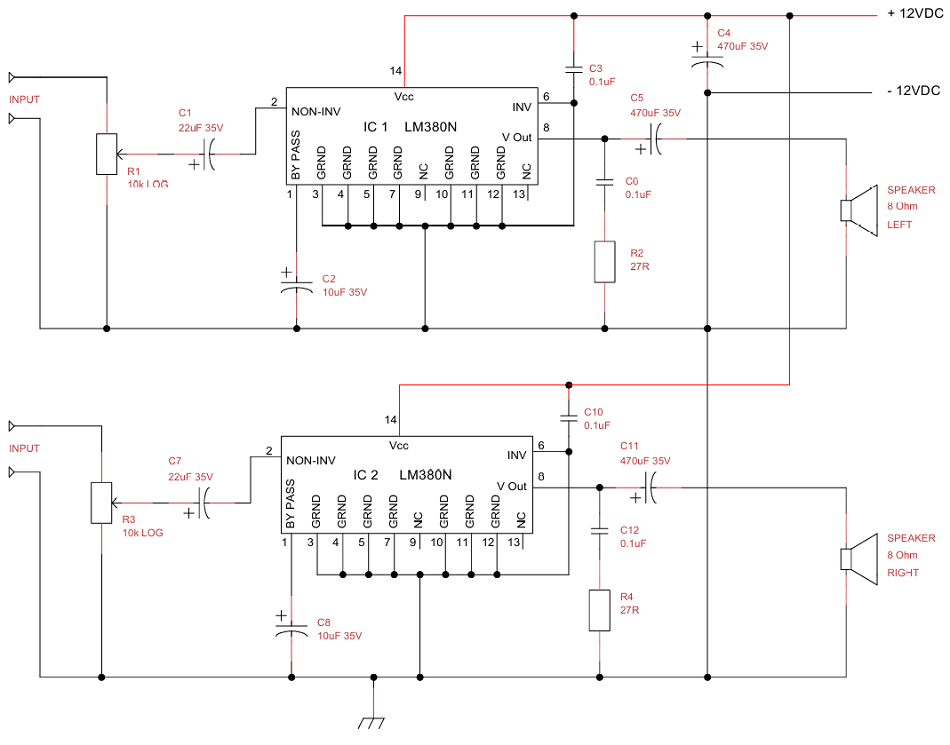
Fig 1 The stereo amplifier schematic
The 22 µF input coupling capacitors (C1 and C7) block any DC voltage while allowing the AC audio signal to pass through to the amplifier. Without them, any DC voltage from the audio source could affect the LM380's input bias and reduce its performance.
Together with the 10 kΩ input resistance created by R1 and R3, the 22 µF capacitors forms a high-pass filter with an approximate cut-off frequency of 0.7 Hz. Since this frequency is well below the human hearing range, all audible bass frequencies pass through the amplifier without noticeable attenuation.
The 10 µF capacitors (C2 and C8) are connected to the bypass pins of the LM380s. They help reduce electrical noise and make the amplifier run more smoothly.
The 0.1 µF capacitors (C3 and C10) are connected across the power supply to filter out high-frequency electrical noise. The 470 µF capacitor (C4) acts like a small energy storage tank, supplying extra current
as reqired.
The amplified signal then passes through the 470 µF output capacitors (C5 and C11). These capacitors block DC voltage from reaching the speakers while allowing the AC audio signal to pass through.
Finally, the 27 Ω resistors (R2 and R4) and the 0.1 µF capacitors (C6 and C12) form a Zobel
networks. This helps keep the amplifier stable and prevents unwanted high-frequency oscillations that could reduce sound quality.
The purpose of the Zobel network is to keep the amplifier stable, especially at high frequencies.
The speaker is not a simple resistor - it also has inductance, which means its electrical resistance changes as the frequency changes. This changing load can sometimes cause the amplifier to become unstable and produce unwanted high-frequency oscillations.
The Zobel network provides the amplifier with a more predictable load at high frequencies. This helps absorb unwanted high-frequency signals, preventing oscillation and improving the overall performance of the amplifier.
Without the Zobel network, the amplifier may still work, but it is more likely to become unstable when connected to certain speakers or long speaker cables.
Construction
The circuit is assembled on single sided
Vero-board PCB
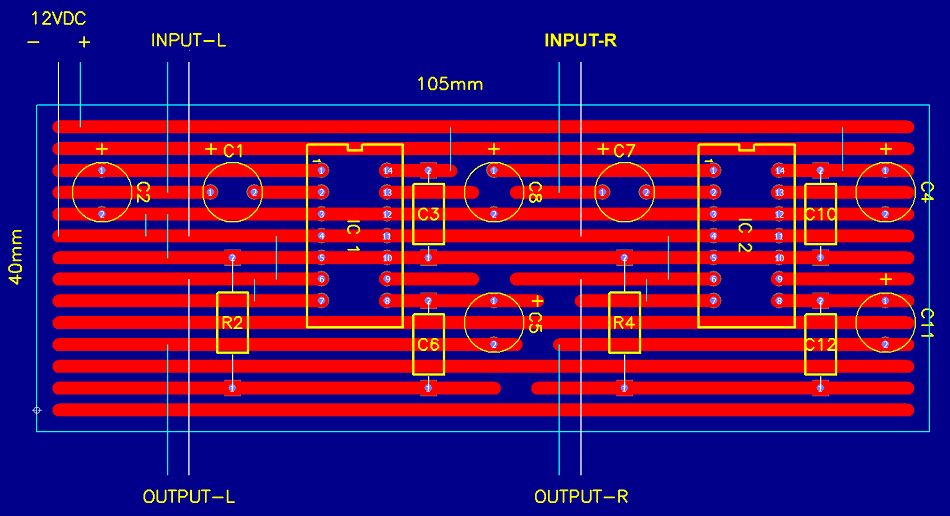
Fig
2 The stereo amplifier components
layout for Vero-board construction.
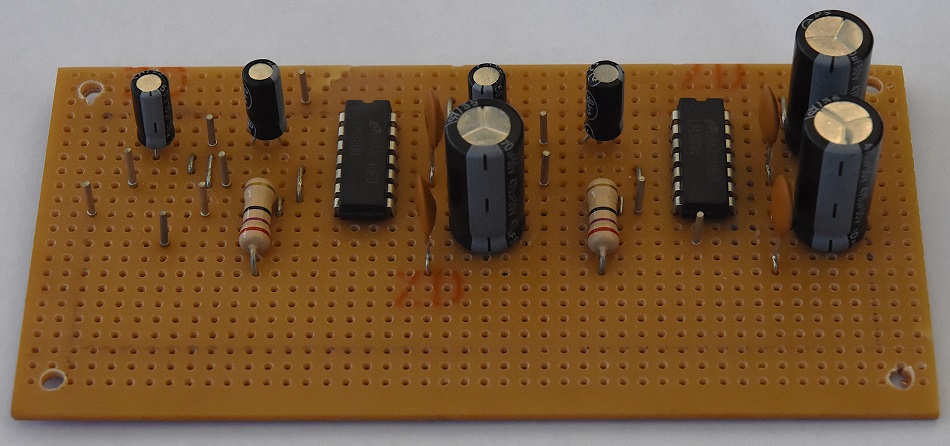
Photo
1 The stereo amplifier Vero-board
completed construction.
The
PC headphone or line output connects directly to the amplifier
inputs using a standard 3.5 mm stereo socket or rear RCA connectors.
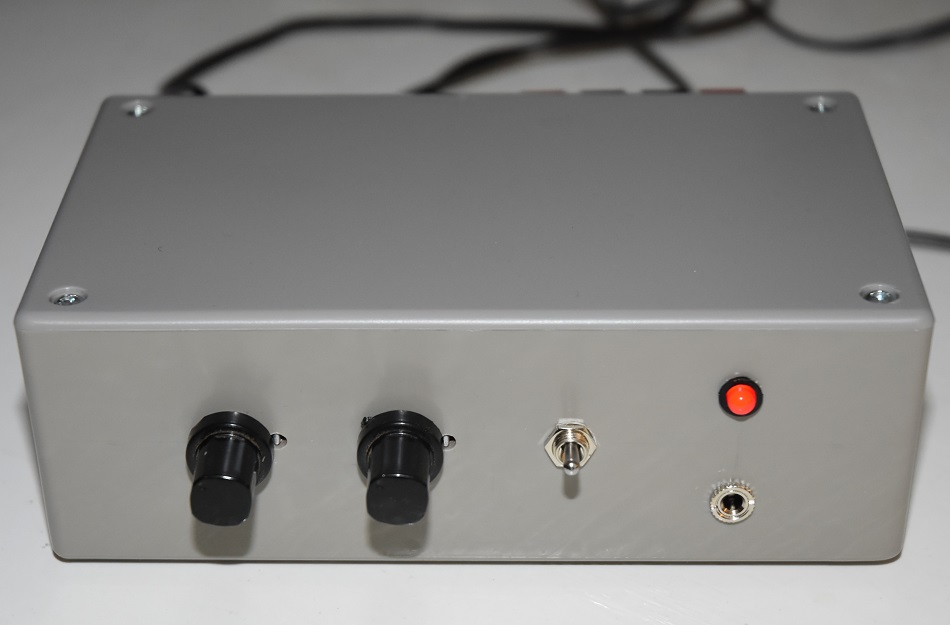
Photo 2 The stereo amplifier front
showing simple left and right channel gain control, on/off switch,
on indicator LED and stereo input jack.
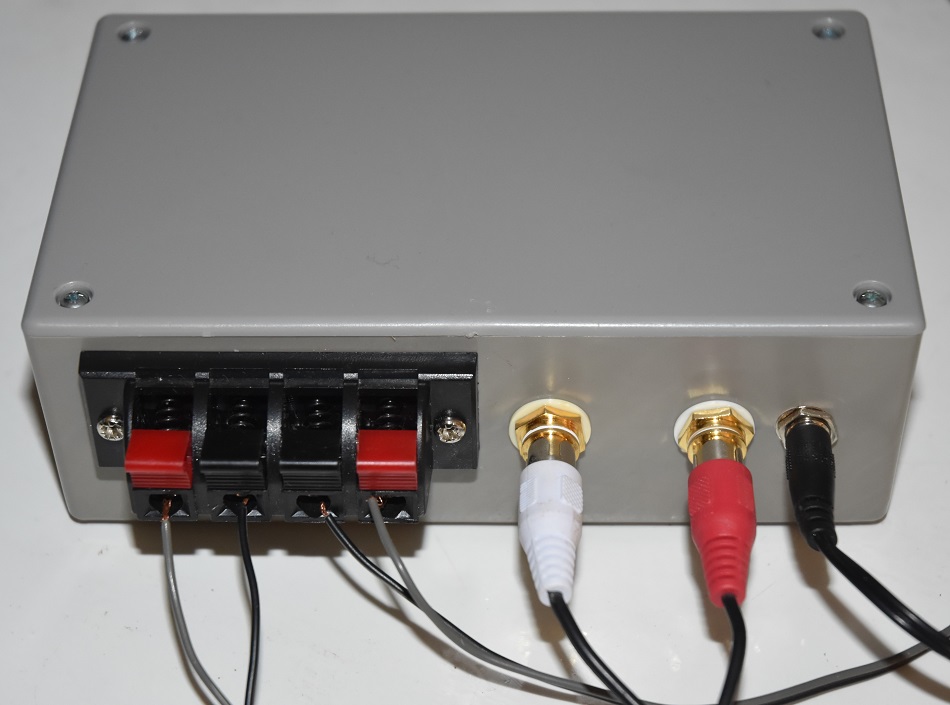
Photo 3 The stereo amplifier rear
showing speaker out connection, left and right channel RCA
connectors and 12VDC supply plug.
Testing Audio Quality
Simple test
method used an audio signal generator, an oscilloscope and 8 Ω dummy load (or speaker).
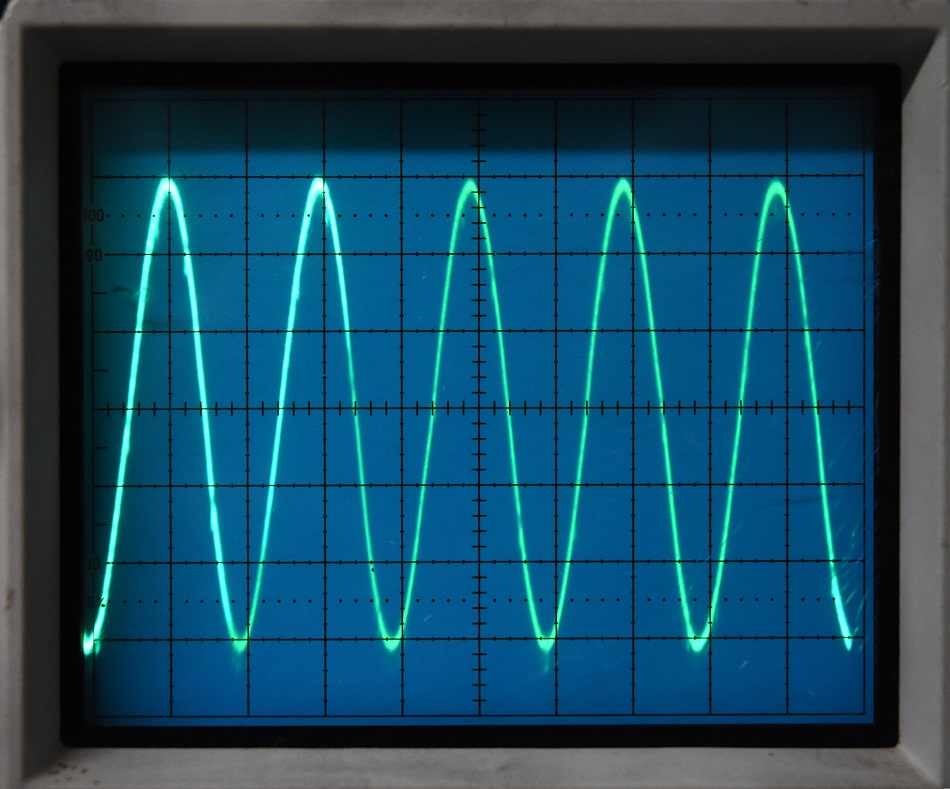
Photo 4 The stereo amplifier out
put display on the oscilloscope showing the ideal perfect sine wave.
Frequency Response Test
The sine wave peak to peak voltage values were recorded from the oscilloscope
measurements per the below table and charted as shown in Fig 2.
|
Frequency
Hz
|
Voltage
pp
|
|
4
|
0.2
|
|
5
|
0.5
|
|
10
|
1.0
|
|
20
|
2.0
|
|
30
|
4.0
|
|
40
|
6.0
|
|
1000
|
6.0
|
|
50000
|
6.0
|
|
150000
|
6.0
|
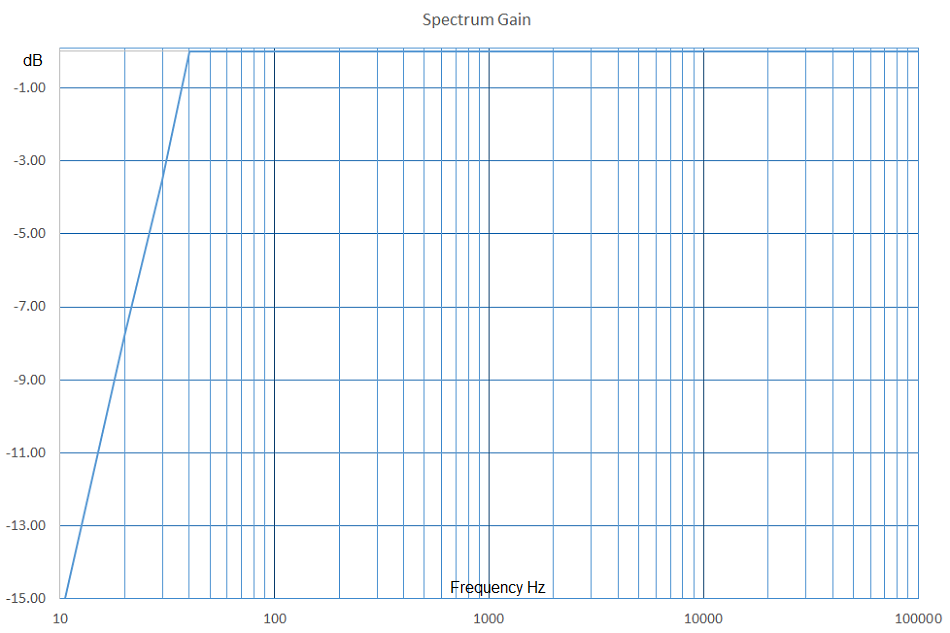
Fig
2 The output level remain very constant from 40Hz
through to 150kHz easily satisfying the human audio range.
The pleasant
surprise of the
LM380 is its sound quality.
Although introduced in 1972, it
produces surprisingly clean audio when operated within its design
limits.
The amplifier has a frequency
response extending well beyond the audible range.
Typical performance is:
20 Hz to over 100 kHz
The practical response is essentially limited by the loudspeakers rather than the amplifier itself.
The
LM380 remained only lukewarm after running the amplifier
continuously for many hours at a good volume, therefore requiring no
further heatsinking.
Conclusion
With a pair
of second-hand Sony bookshelf speakers this amplifier sounds
fantastic and is way better than the typical basic PC speaker set
that I was use to. The
LM380 integrated circuit amplifier is perfectly suitable for this
task, however if a little more power is required a LM384 chip can be
dropped into this circuit with no other changes needed for double
the power (About 5 watts).
References
Texas
Instruments
LM380 audio power amplifier integrated circuit specifications:
LM380
data sheet, product information and support | TI.com
Texas
Instruments
LM384 audio power amplifier integrated circuit specifications:
LM384
data sheet, product information and support | TI.com
TOP
OF PAGE
Page initiated 01
August,
2026
Page
last revised 04 August,
2026
|